


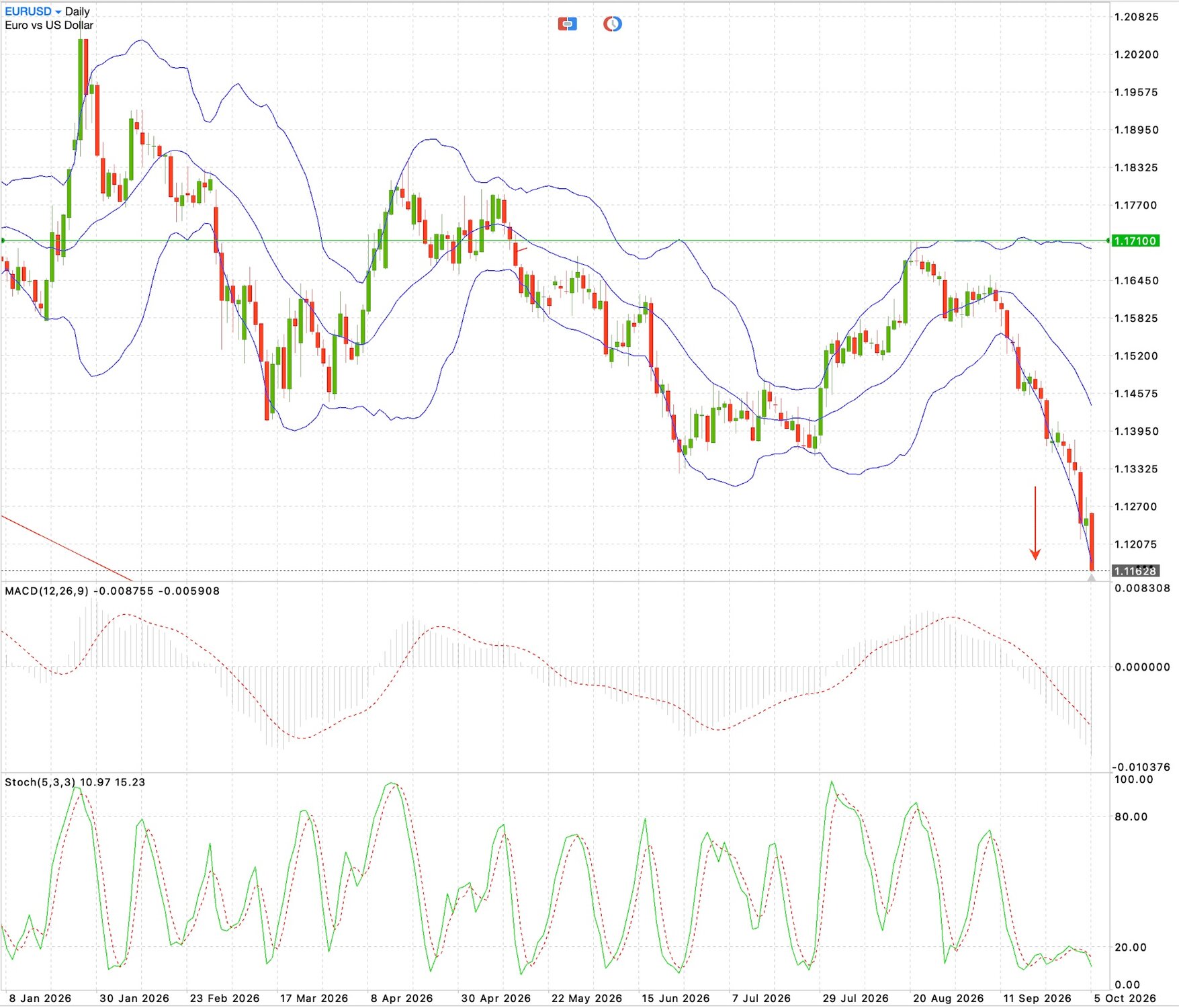
EUR/USD starts the week around 1.1166, close to its lowest levels since May 2025. A weak US labour market report sharply reduced the likelihood of a Federal Reserve rate hike in October, but elevated Treasury yields and fiscal risks in France are preventing the euro from staging a sustained recovery.
- The US economy added only 29,000 jobs in September versus 90,000 expected.
- The probability of the Fed keeping rates unchanged in October rose to around 78%.
- EUR/USD remains near 1.1166, while the market now turns its attention to the ISM Services PMI.
Friday’s NFP report significantly changed expectations for Fed policy. Payrolls increased by just 29,000, the unemployment rate rose from 4.1% to 4.2%, and average hourly earnings growth slowed to 3.0% year-on-year. In addition, July and August payroll figures were revised down by a combined 60,000 jobs.
Against this backdrop, the probability of another rate hike as early as October fell to around 22%. The dollar is pulling back slightly from recent highs on Monday, but EUR/USD remains under pressure. The DXY index is trading near 101.97, while the 10-year Treasury yield stands around 5.26%, only slightly below multi-year highs.
Main macroeconomic driver
Following the NFP report, the market faces another test of the health of the US economy with the September ISM Services PMI.
The consensus expects the index to ease to around 55.0 from 55.4. The employment and prices components will be particularly important: weak employment would reinforce the signal from Friday’s NFP, while persistently high prices would underline why the Fed is not yet ready to rule out further tightening altogether.
The dollar is therefore caught between two opposing forces. A slowing labour market argues against an October rate hike, but elevated inflation, high oil prices and Treasury yields above 5% continue to support the US currency.
Central banks
Following the weak NFP report, markets have almost ruled out a rate hike at the Fed’s 27–28 October meeting, although another move in December is still being priced in. The Fed raised its target range to 3.75–4.00% in September, so the current pause is still being viewed as a break in the tightening cycle rather than its definitive end.
For the euro, the situation is complicated by France. High public debt and political uncertainty continue to weigh on French government bonds and limit support for the single currency, even as markets expect further tightening from the ECB.
Technical outlook
EUR/USD has already moved below the previous 1.1200–1.1215 support area, confirming continued bearish pressure.
The nearest support is now located around 1.1150. A sustained break below this level would bring the 1.1100 area into focus.
Initial resistance is seen at 1.1200–1.1215, followed by 1.1270. For the technical picture to improve more meaningfully, the pair would need to recover above 1.1270–1.1300.
FAQ
Why is the euro not rising after the weak NFP report?
Lower expectations for Fed tightening are supportive for the euro, but this effect is being offset by elevated Treasury yields and fiscal risks in France.
What matters today?
The US ISM Services PMI, particularly its employment and prices components.
Which levels are key?
Support is located at 1.1150 and 1.1100. Resistance is seen at 1.1200–1.1215 and 1.1270.