

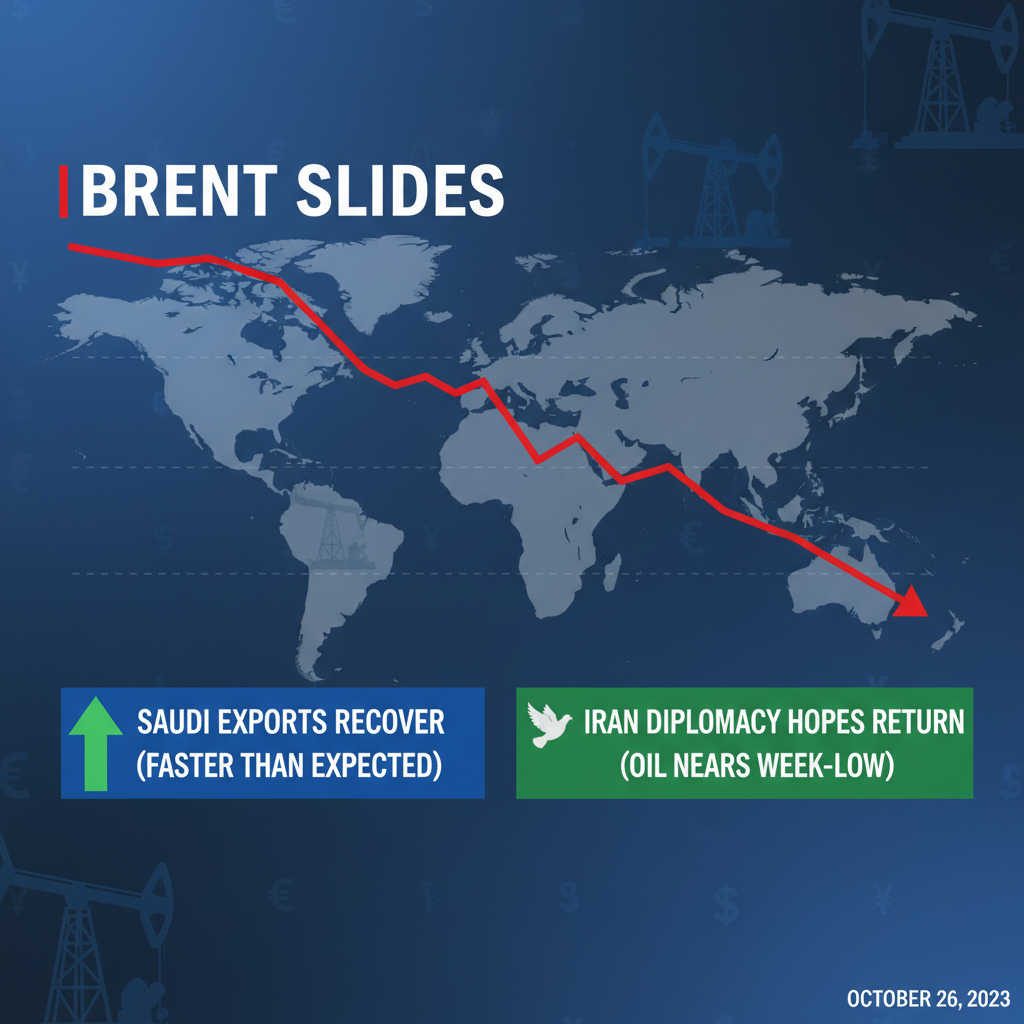
Saudi exports are recovering faster than expected, while renewed hopes for diplomacy with Iran are pushing oil toward its lowest level in more than a week.
Brent is trading around $101.70 per barrel on Monday, down more than 2%.
3 Takeaways
- Saudi crude exports have recovered to above 4 million barrels per day, up from 2.4 million in August.
- Total Middle East oil flows are holding near 17.1 million barrels per day, only slightly below 2025 levels.
- The upcoming UN General Assembly is reviving hopes for diplomatic progress between the US and Iran.
Brent starts the week with its sharpest decline in several days and is trading at its lowest level in more than a week. Until recently, the market had been pricing in the risk of a prolonged decline in Saudi exports following damage to the East–West pipeline, but actual supply flows have proved more resilient.
Saudi Arabia has sharply increased the use of Persian Gulf routes and alternative transshipment arrangements, significantly reducing fears of an immediate physical shortage.
Supply and demand
Saudi exports recovered to above 4 million barrels per day in September, compared with around 2.4 million in August.
Ship-to-ship operations off Oman are also playing an important role. Volumes handled through these transfers have reached around 2.5 million barrels per day and are now supporting a significant share of flows that previously moved directly through the Strait of Hormuz.
The system is more expensive and less efficient, but it has shown that producers can maintain substantial export volumes even when the number of observable tanker passages through the strait remains extremely low.
Macroeconomic factors
Diplomacy has added further pressure on oil prices.
Donald Trump said he was ready to meet Iranian President Masoud Pezeshkian during the UN General Assembly, while Tehran has outlined conditions for restarting negotiations.
For now, this is only a possibility rather than an agreement. But after several weeks of almost continuous escalation, even a limited chance of renewed dialogue is enough for the market to remove part of the geopolitical risk premium.
Technical outlook
Brent has moved directly into the $100–102 area, which now becomes the key support zone.
Holding this area would preserve the broader trading range and allow for a potential recovery toward $104–105.
A break below $100 would represent a more significant technical signal and could open the way toward $97–98.
For the previous bullish momentum to return, Brent would need to regain and hold above $105.
FAQ
Why is Brent falling so sharply?
The market is seeing a real recovery in Saudi exports while also pricing in renewed hopes for diplomatic progress with Iran.
Is the Strait of Hormuz operating normally again?
No. The number of tracked vessels remains extremely low, but alternative logistics and shipments with transponders switched off are allowing much larger oil volumes to move than observable tanker traffic alone would suggest.
What could quickly push oil higher again?
A breakdown in diplomatic contacts, new attacks on Saudi infrastructure, or signs that the recovery in export flows cannot be sustained.